

15 May 2026
The 165 g Pringles Käse & Zwiebel at your local supermarket costs €4.50. The 200 g Pringles Original costs €4.00. You get 35 g less, pay 50 cents more, and end up with chips priced at €2.73 per 100 g instead of €2.00. That is not a bargain — it is a 37% markup dressed up as a snack.
What the data shows
Sivix collected price records for Pringles across multiple sizes in Germany. The pattern is consistent and unambiguous.
| Product | Size | Median price | Per 100 g |
|---|---|---|---|
| Pringles Original XXL | 200 g | €4.00 | €2.00 |
| Pringles Sour Cream & Onion XXL | 200 g | €4.07 | €2.04 |
| Pringles Ketchup | 165 g | €4.30 | €2.61 |
| Pringles Käse & Zwiebel | 165 g | €4.50 | €2.73 |
The 165 g Ketchup costs €0.30 more than the 200 g Original, yet delivers 35 g less product. On the same basis, you are paying €2.61 for what costs €2.00 in the larger format — a 30% premium. And this is not one flavour's quirk: across six 165 g Pringles flavours tracked in Germany, four sit at exactly €4.50, with 44–90 price observations each. The €4.50 price for 165 g is no coincidence; it is a shelf price.
The same mechanism shows up in nuts. Ültje's 180 g roasted peanuts have a median price of €3.50 in Germany — €1.94 per 100 g. The 150 g pack sits at €3.69, or €2.46 per 100 g. The smaller bag costs 27% more per gram. You pay €0.19 more for 30 g less.
Why this happens
The economics of packaged goods do not scale linearly with weight. Manufacturing, transport, and shelf space are all relatively fixed costs — and the psychology around the core unit of purchase is relatively fixed, too: a can is a can, whether it holds 165 g or 200 g. Retailers and brands exploit the fact that shoppers compare ticket prices, not per-gram prices. A €4.50 sticker feels like a reasonable snack purchase. No one stands in the snacks aisle doing long division.
The XXL format exists partly as a promotional entry point — it justifies a higher absolute price by anchoring on volume. But it also inadvertently reveals how aggressively the smaller format is priced. When you can see both on the same shelf, the maths is visible. Most of the time, they are in different store layouts, different promotions, or different mental categories.
What it means for you
If you buy Pringles twice a month, you spend around €108 a year on the 165 g Käse & Zwiebel. Switch to the 200 g format at €4.00 and the same 24 purchases cost €96 — €12 saved, and you would also get 840 g more crisps. That is not a lifestyle overhaul. It is the same shelf, the same trolley, a different can. When both sizes are available, check the price-per-100 g label required by German law. The bigger can is almost always cheaper per gram.
Small-pack premium — two categories (per 100 g, Germany)
| Label | Value |
|---|---|
| Ültje peanuts 180 g | 1.94 |
| Pringles Original XXL 200 g | 2.0 |
| Ültje Studentenfutter 150 g | 2.46 |
| Pringles Ketchup 165 g | 2.61 |
| Pringles Käse & Zwiebel 165 g | 2.73 |
Source: Sivix, 201 price records · Pringles + Ültje · Germany · Feb–Apr 2026
Data source: Based on 201 price records collected by Sivix users in Germany. Data reflects real shelf prices as reported at time of purchase (February–April 2026).
Products referenced in this story
Real shelf prices as reported by Sivix contributors. Tap any product to see current prices.
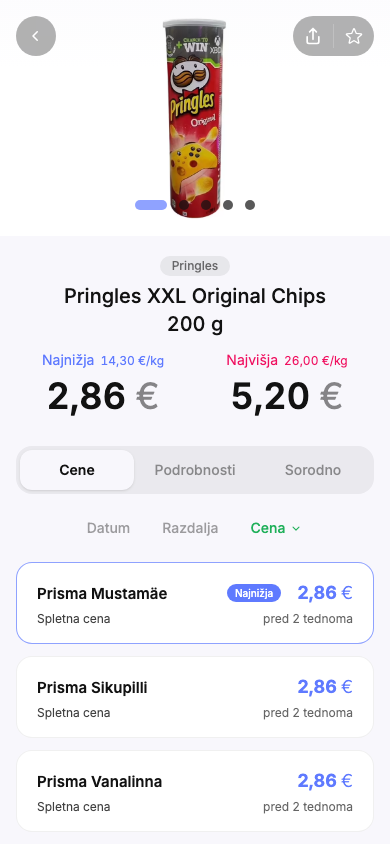
200 g XXL format — €2.00/100 g — €4.00/can
Pringles Original 200 g
DE · View on Sivix →
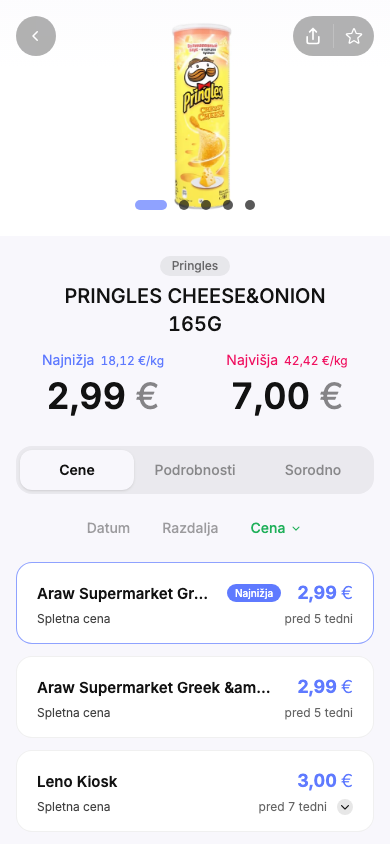
165 g format — €2.73/100 g — €4.50/can
Pringles Käse & Zwiebel 165 g
DE · View on Sivix →
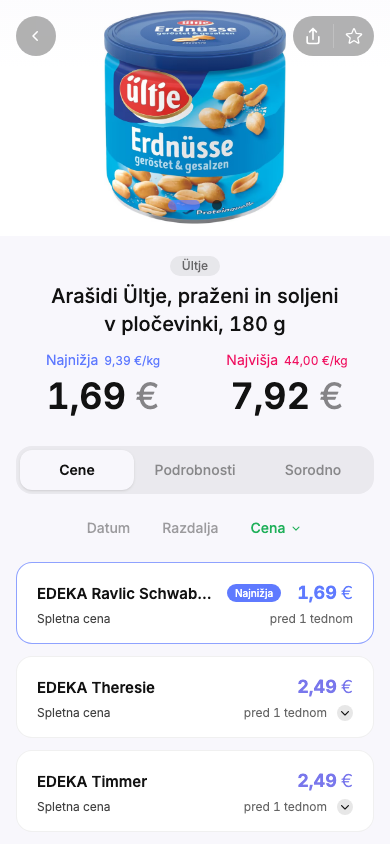
180 g format — €1.94/100 g — €3.50/bag
Ültje Erdnüsse 180 g
DE · View on Sivix →
- Pringles Original 200 g DE · €4.00 · €4.00/can →
- Pringles Käse & Zwiebel 165 g DE · €4.50 · €4.50/can →
- Ültje Erdnüsse 180 g DE · €3.50 · €3.50/bag →
- Pringles Sour Cream & Onion 200 g DE · €4.07 · €2.04/100 g →
- Pringles BBQ Onion 200 g DE · €3.99 · €2.00/100 g →
- Pringles Hot and Spicy 200 g DE · €4.30 · €2.15/100 g →
- Pringles Ketchup 165 g DE · €4.30 · €2.61/100 g →
- Ültje Studentenfutter 150 g DE · €3.69 · €2.46/100 g →