

21 April 2026
Why don't laundry detergent prices sit still? Because they aren't meant to. Across four European markets where we can track prices over months, the same premium-brand bottle swings 80% to 165% between its cheapest and dearest weeks. The own-label bottle next to it barely moves. The question isn't whether your detergent is "on sale" today. It is: does the brand you buy play the game at all?
What the data shows
Four multi-day markets, four different retail cultures, one pattern. Premium brands cycle hard; own-label sits still.
| Market | Premium swing | Own-label / value line |
|---|---|---|
| Slovenia | Ariel, Persil, Dash: 106% avg (29 SKUs) | Spar, Tuš: 14–21% |
| Germany | Spee 22 pods: +163%; Perwoll 27: +48–72% | Denkmit: near-flat |
| Finland | Omo 1.84 L: +84%, median 80% of max | LV (Lidl): +59%, mostly flat |
| Spain | Wipp 33 pods: +83%; Dixan: +63–76% | Consum pods: flat at €3.99 |
The extreme case is Slovenian Ariel 3.87-litre Mountain Spring: €19.69 to €43.99 across 20 tracked days, a 123% swing on one bottle. At the other extreme, Slovenian own-label Spar 3-litre Gel has moved €5.79 to €6.99 over the same period — 21% maximum swing. Premium detergent is roughly seven times more volatile than the own-label on the same shelf.
Two country-level variations give the pattern texture. In Finland, premium brands swing as wildly as elsewhere, but the median week sits near the top of each SKU's range — Omo 1.84 L at 0.80 median/max means most weeks are priced near the €14.60 high, and the €7.95 low is a narrow window. The swing is real; the discount is short. In Slovenia the story is gentler: the median Ariel 3.87 L week is €39.29 in a €19.69–€43.99 range, with plenty of weeks scattered through the middle. Slovenian shoppers who watch the flyer actually catch the low price regularly.
Why this happens
Hi-lo pricing is a business model, not a flaw. Premium detergent manufacturers — P&G (Ariel, Dash), Henkel (Persil, Spee, Wipp, Dixan), Unilever (Omo) — set a high list price with retailers; both parties then profit from frequent promotional "deals" stepped down from that list. The high anchors brand value in shopper memory. The promo feels like a win. The retailer gets a headline discount for the weekly flyer; the manufacturer defends its positioning without permanently cutting list.
Own-label gel — Spar, Tuš, Denkmit, Consum, Bosque Verde, Lidl's LV and Wau! — plays EDLP: every-day low price. No price anchoring because the house label doesn't have brand equity to anchor. No theatrical discount because there's no margin to play with. Just a flat, fair shelf price that is roughly the same any week of the year.
The volatility ratio between premium and own-label runs five to eight times in every market we can measure. That isn't about country-specific quirks. It is the same economic model — premium brand versus private label — playing out in Ljubljana, Munich, Helsinki and Madrid.
What it means for you
If the brand you buy is cycling — Ariel, Persil, Wipp, Spee — the question is when, not whether. Buying on the promo week instead of the regular one saves a real household €20–€50 per year, depending on the market and brand. If the brand you buy is not cycling — Spar, Tuš, Denkmit, Consum — the shelf price is already the fair one, and timing doesn't matter.
A shopper who switches from "premium on habit" to "premium on flyer only" keeps the difference. A shopper who switches to own-label keeps considerably more.
Same shelf, different rules — max-to-min swing by SKU (%)
| Label | Value |
|---|---|
| DE Spee 22 pods (premium) | 163 |
| SI Ariel 3.87 L (premium) | 123 |
| FI Omo 1.84 L (premium) | 84 |
| ES Wipp 33 pods (premium) | 83 |
| SI Spar 3 L (own-label) | 21 |
| ES Consum pods (own-label) | 0 |
Source: Sivix, 4 markets, Jun 2025 – Apr 2026
Data source: Based on 10,000+ price records across four multi-day markets (SI, DE, FI, ES) between 2025-06-26 and 2026-04-07. Slovenia provides the longest series at 131 days; Finland and Germany each ~10 weeks; Spain 16 weeks. Each cited SKU has at least four observations. Data reflects real shelf prices as reported at time of purchase.
Products referenced in this story
Real shelf prices as reported by Sivix contributors. Tap any product to see current prices.
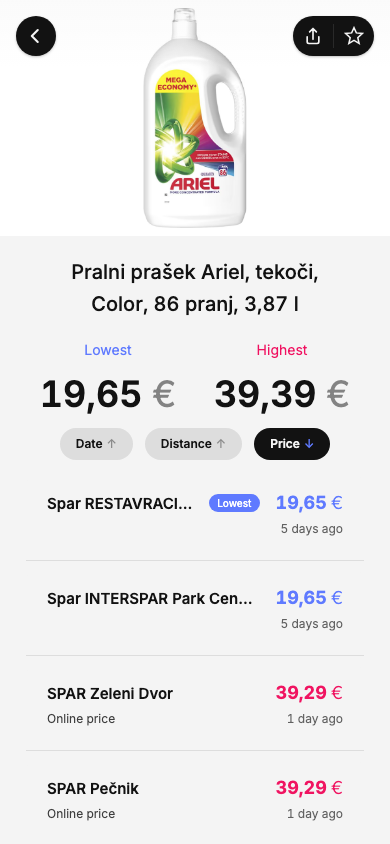
Premium worst — +123%
Ariel Color 86 washes, 3.87 L
Slovenia · View on Sivix →
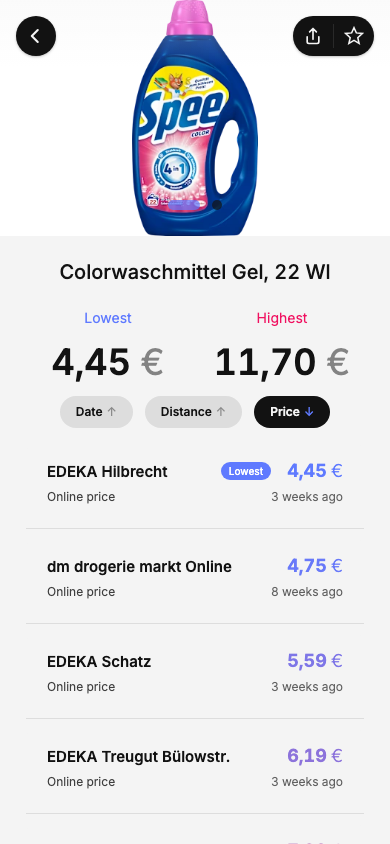
Worst pod swing — +163%
Spee Color Gel, 22 pods
Germany · View on Sivix →
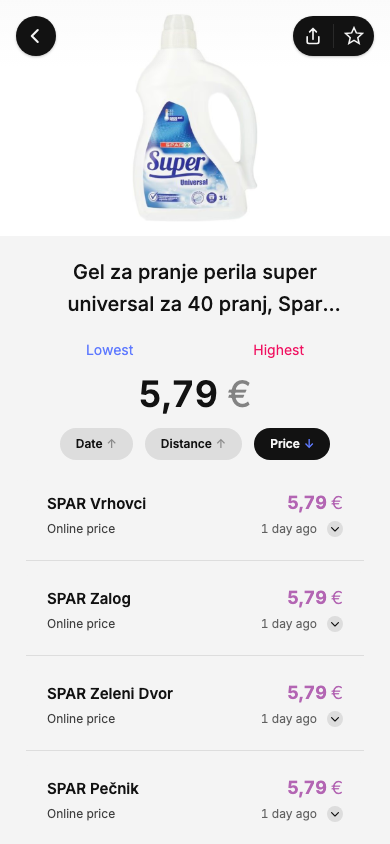
EDLP reference — +21%
Spar Super Universal, 3 L
Slovenia · View on Sivix →
- Ariel Color 86 washes, 3.87 L Slovenia · €19.69–€43.99 · +123% →
- Spee Color Gel, 22 pods Germany · €4.45–€11.70 · +163% →
- Spar Super Universal, 3 L Slovenia · €5.79–€6.99 · +21% →
- Omo Color, 1.84 L Finland · €7.95–€14.60 · +84% →
- Wipp Power Antiolores, 33 pods Spain · €6.99–€12.79 · +83% →
- Consum Cápsulas Color, 24 pods Spain · €3.99 · flat →