
The cheapest bottle of olive oil on the Croatian shelf costs more per litre than the median bottle in Spain. Croatia borders the Adriatic, grows its own olives, and produces award-winning oil. Spain is the world's largest olive oil producer. And yet Croatian shoppers pay 2.6 times more.
What the data shows
In Spain, the median litre of olive oil costs €5.99. Half of all bottles in Spanish supermarkets are under €6 a litre. Carbonell Extra Suave, a 1L bottle: €5.20. Carbonell EVOO: €6.82. Hojiblanca EVOO: €7.79. Even a DOP-certified Priego de Córdoba costs €5.95.
In Croatia, the cheapest mainstream 1L olive oil — Trenton, a basic-grade oil — is €8.99. That's already 50% above Spain's median, and that's the floor. Oliveta EVOO 1L: €9.85. Zvijezda, Croatia's most-recognised domestic brand: €9.99. Then it climbs: Farchioni (Italian) at €12.09, Monini (Italian) at €13.39, Orgula at €15.05. The Croatian artisanal oils in 250ml and 500ml bottles — the ones from Istria and Dalmatia with hand-lettered labels — run €34 to €68 per litre. The median across all 52 products: €15.45.
A Croatian family that goes through a litre a week pays around €490 more per year on olive oil than a Spanish family doing the same shopping.
Croatia: olive oil price ladder — €/litre (1L bottles)
| Product | Price (€/litre) |
|---|---|
| Trenton (basic grade) | 8.99 |
| Oliveta EVOO | 9.85 |
| Zvijezda EVOO | 9.99 |
| Farchioni EVOO | 12.09 |
| Monini EVOO | 13.39 |
| Orgula EVOO | 15.05 |
Source: Sivix, Croatia, April 2026
Why this happens
Spain produces roughly 45% of the world's olive oil. Retail prices at home are suppressed by sheer proximity: groves, mills, bottlers, and supermarkets are all in the same country, and distribution costs a fraction of what it costs to move oil across borders.
Croatia produces olive oil too — but in small volumes. Most of the best Istrian and Dalmatian oil is bottled in 250–500ml formats and sold as premium product, often exported. What fills Croatian supermarket shelves is largely imported from Italy and Spain, arriving with export margins, distributor markup, and Croatian VAT (25%, versus Spain's 10% on food oils) stacked on top. The result: even Italian and Spanish brands cost twice as much in Zagreb as they do at home.
What it means for you
If you're shopping in Croatia, there is no €5 litre. The cheapest credible option is around €9, and the median is nearly €16. The practical response is to buy the largest bottle you'll reasonably use before it oxidises — some Croatian retailers stock 3L formats that bring the per-litre cost down meaningfully. But the structural gap to Spain isn't a supermarket problem. It's baked into the supply chain.
Data source: Based on 508 price records collected by Sivix users across Croatia and Spain. Data reflects real shelf prices as reported at time of purchase.
Products referenced in this story
Real shelf prices as reported by Sivix contributors. Tap any product to see current prices.
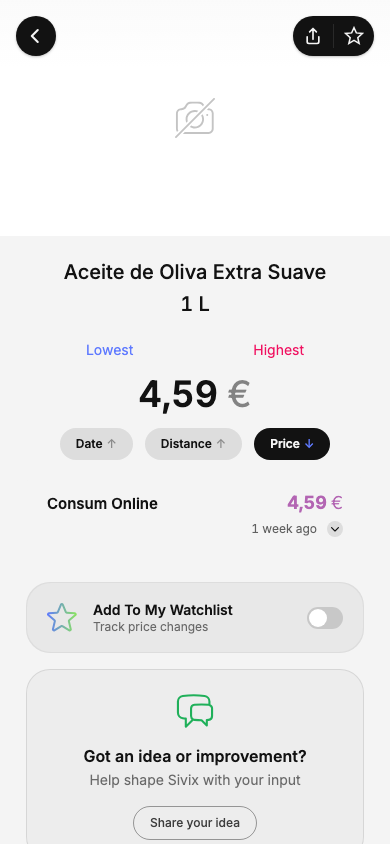
Spain — €5.20/L
Aceite de Oliva Extra Suave, 1 l, Carbonell
Spain · View on Sivix →
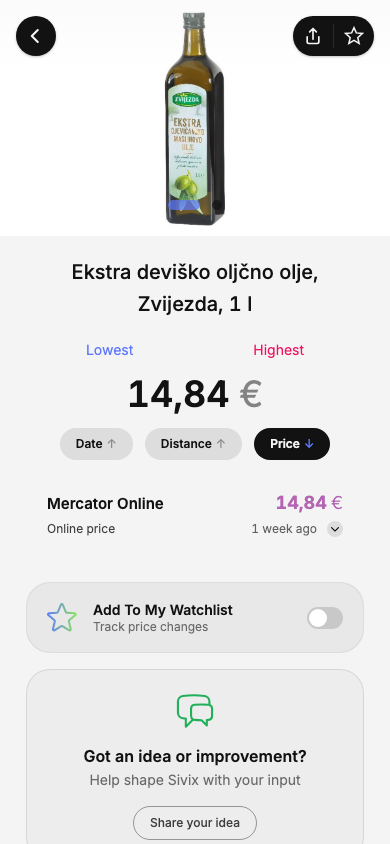
Croatia domestic — €9.99/L
Zvijezda Ulje Ekstra Djevičansko Maslinovo 1 l
Croatia · View on Sivix →
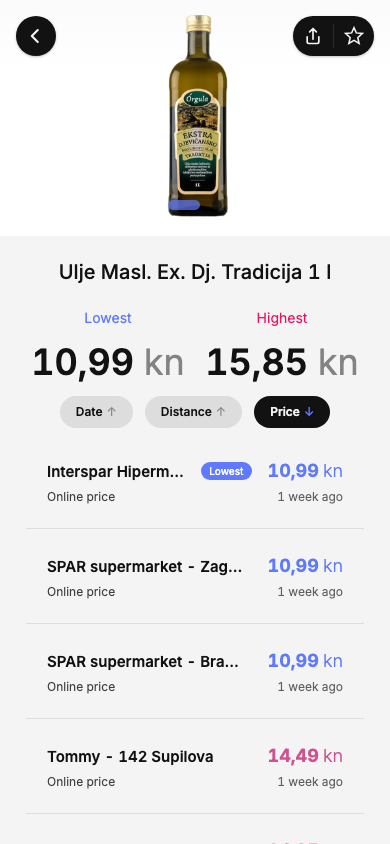
Croatia median — €15.05/L
Orgula ekstra djevičansko maslinovo ulje, 1 l
Croatia · View on Sivix →
- Aceite de Oliva Extra Suave, 1 l, CarbonellES · €5.20/L→
- Aceite de Oliva Virgen Extra, 1 l, CarbonellES · €6.82/L→
- Aceite Oliva Virgen Extra Botella, 1 l, HojiblancaES · €7.79/L→
- Maslinovo ulje, 1 l, TrentonHR · €8.99/L→
- Maslinovo ulje extra djevičansko, 1 l, OlivetaHR · €9.85/L→
- Zvijezda Ulje Ekstra Djevičansko Maslinovo 1 lHR · €9.99/L→
- Farchioni ekstra djevičansko maslinovo ulje, 1 lHR · €12.09/L→
- Monini classico extra vergine di oliva 1 lHR · €13.39/L→
- Orgula ekstra djevičansko maslinovo ulje, 1 lHR · €15.05/L→