

The cheapest egg in the Sivix database costs ten cents. It is Spanish. It is also a quail egg.
What the data shows
Set that aside. Among chicken eggs, Europe's price map is surprisingly flat. The median price per egg ranges from €0.315 in Estonia to €0.399 in Slovakia — a 27% spread across five EUR markets. Compare that to butter (a 2× gap across the same region) or coffee pods (2.2×), and eggs look almost like a commodity.
| Market | Median per egg | Note |
|---|---|---|
| Estonia | €0.315 | indicative (8 records) |
| Spain | €0.346 | EUR |
| Finland | €0.348 | EUR |
| Slovenia | €0.364 | EUR |
| Slovakia | €0.399 | EUR |
Non-EUR markets sit in the same band: Poland €0.352, Sweden €0.385, Czech Republic €0.383. Geography, for once, is not the story.
What moves the needle is the farm. In Finland, a conventional egg costs €0.35. A certified organic Laitilan iso luomu L costs €0.67 — 91% more, same protein, same shell. In Slovakia, the organic premium nearly doubles the price: Tesco Bio vajcia M comes in at €0.479 against a conventional median of €0.249. That is 92% for the right sticker on the box.
Farm-type price ladder — Finland (€/egg)
Source: Sivix Finland, Apr 2026
Why this happens
Chicken eggs are produced everywhere in Europe, so there is no long-haul transport cost to exploit. Supply chains are local, and the price floor is set by industrial barn farming, which is efficient and consistent across borders.
Organic certification breaks that logic. Slower growth cycles, lower flock density, and certified feed all add real cost — but the premium in the market frequently runs ahead of those costs. Shoppers who buy organic eggs tend not to shop around. The price sticks.
What it means for you
If you are buying conventional eggs, moving country barely changes your bill. At three eggs a day, the difference between Estonia's median and Slovakia's is €84 a year — real, but not life-changing.
If you are buying organic, the math looks different. The gap between the budget option (€0.186 per egg, FI X-tra) and the premium organic (€0.665 per egg, Laitilan luomu) is €524 a year on the same consumption. That is a choice worth making consciously.
Your country adds €0.08 to your egg. Your farm choice adds €0.48. Buy accordingly.
Products referenced in this story
Real shelf prices as reported by Sivix contributors. Tap any product to see current prices.
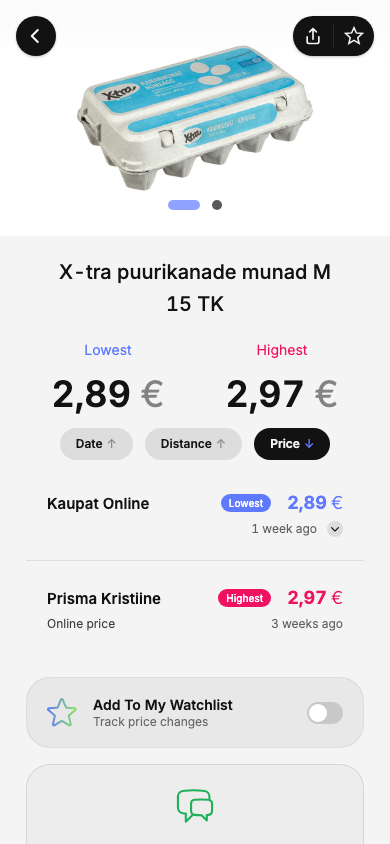
Budget — €0.186/egg
X-tra munad M 15-pack
Finland · View on Sivix →
Quail — €0.103/egg
Huevo Codorniz quail 18-pack
Spain · View on Sivix →
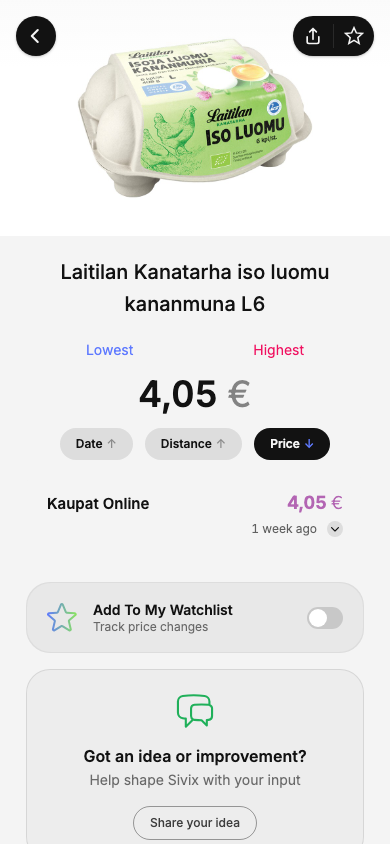
Premium organic — €0.665/egg
Laitilan luomu L 6-pack
Finland · View on Sivix →
- Huevo Codorniz quail 18-packES · €0.103/egg→
- Prepeličja jajca quail 12-packSI · €0.183/egg→
- X-tra munad M 15-packFI · €0.186/egg / EE · €0.198/egg→
- Juniorky free-range S 10-packSK · €0.249/egg→
- Kotimaista mahe kanamunad M6EE · €0.438/egg→
- Kultamuna luomu S/M 6-packFI · €0.471/egg→
- Tesco Bio vajcia M 10-packSK · €0.479/egg→
- Huevo Ecológico L-XL 6-packES · €0.610/egg→
- Bio Jajca Slovenske Dobrote 6-packSI · €0.665/egg→
- Laitilan luomu L 6-packFI · €0.665/egg→
Data source: Based on ~440 price records across 5 EUR markets collected by Sivix users. Data reflects real shelf prices as reported at the time of purchase.