

Finland is not known for cheap groceries. But the Sivix database says Finnish butter costs half what German butter does — and the cheapest stick in the whole EUR database comes from Slovakia, at €0.695 per 100 grams.
What the data shows
The median price per 100g of butter ranges from €1.037 in Finland to €2.116 in Germany — a 2× gap across nine EUR markets.
| Market | Median per 100g |
|---|---|
| Finland | €1.037 |
| Greece | €1.420 |
| Slovakia | €1.490 |
| Spain | €1.516 |
| Estonia | €1.620 |
| Latvia | €1.695 |
| Slovenia | €1.836 |
| Lithuania | €1.880 |
| Germany | €2.116 |
Non-EUR markets cluster in the middle: Poland at €1.41, Czech Republic €1.58, Sweden €1.57.
The same Valio 500g butter shows how the premium compounds as it travels. In Finland it costs €1.302 per 100g. In Estonia, €1.574. By the time it reaches Latvia, €1.720 — a 32% markup on a product that started 300 kilometres away.
But cross-border pricing is almost a sideshow. The bigger gap is within any single market. In Slovenia, S-Budget Maslo costs €0.732 per 100g. Soster's organic lactose-free butter costs €3.008 — 4.1× more, same shelf, same trolley. In Germany, basic Meggle is €1.036; the Kräuterbutter herb roll is €2.662 — 2.6×.
Brand-tier price ladder — Slovenia (€/100g)
Source: Sivix Slovenia, Apr 2026
Why this happens
Finland's low median is structural. Valio dominates domestic dairy, runs efficient large-scale production, and fills shelves with blended variants like Oivariini that pull the median down. Short supply chain, dominant domestic brand, competitive own-label tier. Finland's butter advantage evaporates entirely in the organic and specialty section — at that level, every market converges.
Germany's high median reflects fragmented sourcing, strong import brands, and a retail environment that sustains premium pricing across dozens of SKUs.
What it means for you
At 250 grams a week — a typical household — the country-level gap costs €140 a year. That is the difference between buying Finnish median butter and German median butter for the same volume.
The brand gap within your own market can cost twice that. Buying premium herb butter in Germany instead of basic Meggle adds €210 a year. The Finnish origin advantage is real. The label upgrade is optional.
Your country moves your butter bill by €140. Your brand choice moves it by €210. Choose your label carefully.
Products referenced in this story
Real shelf prices as reported by Sivix contributors. Tap any product to see current prices.
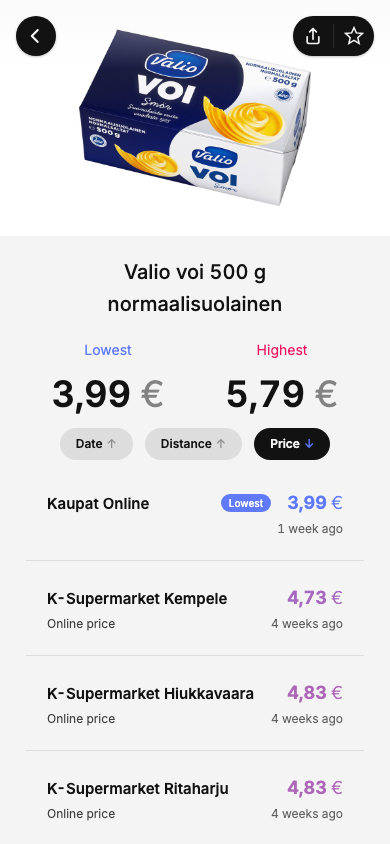
Finland median — €1.037/100g
Valio voi 500g
Finland · View on Sivix →
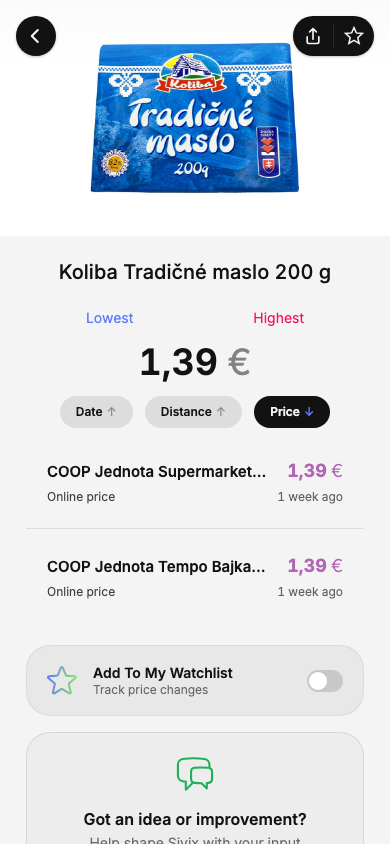
Cheapest EUR — €0.695/100g
Koliba Tradičné maslo 200g
Slovakia · View on Sivix →
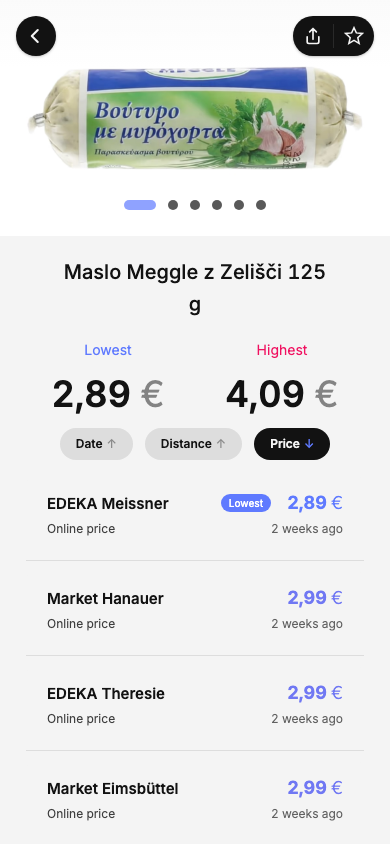
Premium — €2.662/100g
Meggle Kräuterbutter 125g
Germany · View on Sivix →
- Koliba Tradičné maslo 200gSK · €0.695/100g→
- S-Budget Maslo 250gSI · €0.732/100g→
- Valio KevytLevi 400gFI · €0.930/100g→
- Valio voi 500gFI · €1.037/100g→
- Valio Sviests 500gFI €1.302 → EE €1.574 → LV €1.720→
- Lurpak Fácil Untar 200gES · €1.745/100g→
- Valio Eila lactose-free 200gFI €1.677 / LV €1.708 / LT €1.795→
- Meggle Kräuterbutter 125gDE · €2.662/100g→
- Maslo brez laktoze bio Soster 125gSI · €3.008/100g→
- President La Motte salted 250gEE · €3.196/100g→
Data source: Based on ~2,100 price records across 9 EUR markets collected by Sivix users. Data reflects real shelf prices as reported at the time of purchase.